Hickock and Smith receive death sentences
In Cold BloodHickock and Smith receive death sentences at the end of their trial, when a jury finds each man guilty on four counts of first-degree murder and assigns the maximum penalty. The verdict turns the state’s demand for death into a formal judgment, after a courtroom contest over shared responsibility, religious authority, mercy, and the meaning of punishment. Its immediate finality is followed by years of appeals and imprisonment.
The closing arguments
The final session drew a larger and more varied audience than the earlier proceedings. Finney County’s wealthy ranching circle had largely avoided the trial, with one prominent rancher’s wife suggesting that curiosity about such a case was socially improper. On the last day, however, some members of the local establishment attended as a courtesy to Judge Tate and Logan Green, while visiting lawyers filled several benches to hear Green’s address. Green, a well-regarded criminal lawyer usually known for defending clients, had been retained by the state to assist the less experienced county attorney, Duane West.
Before Green spoke, Judge Tate gave the jury his instructions and West made the prosecution’s closing argument. West maintained that both defendants were equally guilty whether or not the jury could determine which one had fired Richard Eugene Hickock’s shotgun. He asked for death, presenting the request as enforcement of the law rather than vengeance. This argument made joint responsibility central: the state did not need the jury to settle the precise division of physical acts in order to hold both men accountable.
The defense made two appeals for mercy, grounded in different arguments. Arthur Fleming invoked the distinction between the human body and the soul, arguing that the state should not destroy the body that houses the soul. Harrison Smith centered his address on opposition to capital punishment, describing it as barbaric, ineffective as a deterrent, and damaging to the value of human life. He asked the jury to choose life imprisonment instead. The book records that at least one juror seemed inattentive during these pleas, a small sign of the strain and duration of the proceedings before Green took the floor.
Green answered the defense by first turning its religious appeal back toward the jury. Without notes, he invoked biblical passages that distinguish unlawful killing from the death penalty imposed for murder, and used a familiar courtroom maneuver: after appearing to lose his place in the Bible, he continued from memory. He then set aside extended theological debate and returned to the state statute, which allowed either life imprisonment or death by hanging for first-degree murder. His case for the maximum penalty rested on the murders as calculated acts committed for a small amount of money. He emphasized the four victims’ helplessness and the family’s shared ordeal, arguing that the jury should judge the defendants’ conduct across all four counts rather than reduce the case to the minimum sentence on one count.
The verdict in court
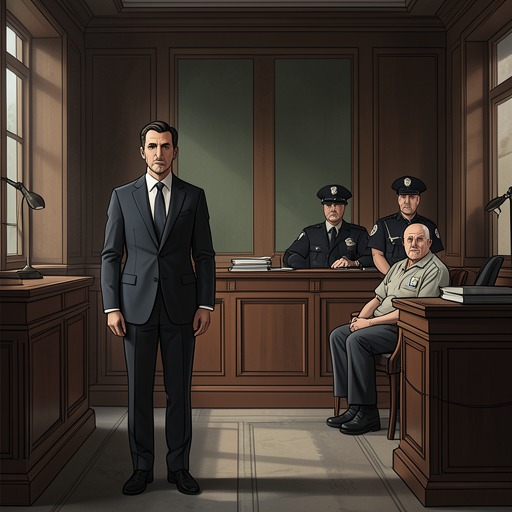
The jury deliberated for forty minutes. Many spectators remained in their seats, expecting a quick decision, while Judge Tate had to be brought back from his farm, where he had gone to feed his horses. He returned in a hastily donned black robe and asked the foreman whether the jury had reached its verdicts. The foreman said that it had, and the bailiff carried the sealed documents to the bench.
As Tate read, the noise of an approaching Santa Fe train could be heard in the courtroom. The first verdict found Richard Eugene Hickock guilty of first-degree murder and imposed death. Tate then read the remaining seven counts: three more convictions for Hickock and four for Perry Smith. The result was four first-degree murder convictions and a death sentence for each defendant. Tate repeated the penalty as he read the successive verdicts, then thanked the jurors for their service and dismissed them.
Both men stood handcuffed to guards and appeared impassive while the sentences were read. At the door, Smith made a joking remark about the jurors’ courage, and he and Hickock laughed. A cameraman photographed them; a Kansas newspaper later printed the picture with a caption asking whether it was their last laugh. The image gave the public a final, ambiguous tableau of the defendants at trial: the sentence had been pronounced, but their visible response resisted the solemnity the courtroom had imposed.
The sentence’s immediate human consequences
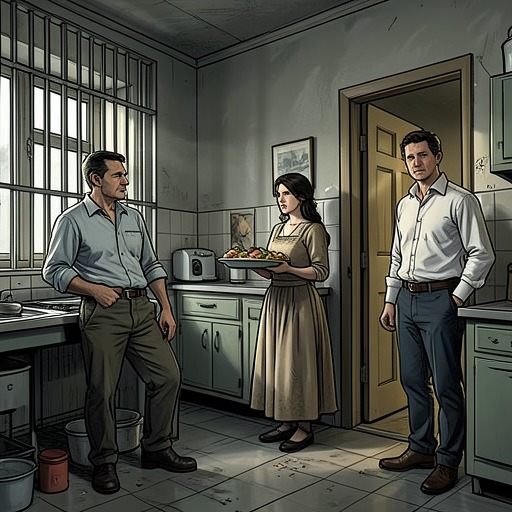
The verdict also changed the atmosphere around Smith’s relationships outside the courtroom. Mrs. Meier, who had come to know him during his confinement, later recalled that she shut herself in her kitchen rather than watch him return after the verdict. From there, she heard him crying. She went to the cell and held his hand; Smith conveyed his shame to her. The next day he would not eat the Spanish rice she prepared and spoke little. When he was taken away to the penitentiary, however, he thanked her and gave her a photograph of himself at sixteen, saying that he wanted her to remember him as the boy in it.
The separation was painful for Mrs. Meier, who knew where Smith was going and what the sentence meant for his future. Even the squirrel he had kept returning to his cell, apparently looking for him, would not accept food from her. These details do not alter the jury’s judgment, but they show the verdict’s reach beyond the legal record: it ended Smith’s place in the household routine and turned a personal bond into a farewell. The sentencing day thus carried different meanings at once—a public declaration of state punishment and a private rupture for people who had known the defendants as individuals.
Appeals, imprisonment, and execution
The death sentences did not lead directly to execution. While confined on Death Row, Hickock and Smith pursued appeals, and their lawyers carried the case to the United States Supreme Court three times. The Court refused to grant the writs of certiorari that would have brought the appeals before it for full hearings. After the men had spent almost two thousand days in their Death Row cells, the Kansas Supreme Court set an execution window between midnight and 2:00 a.m. on April 14, 1965. Governor William Avery later declined a clemency appeal, saying that intervention would not be in the best interest of the people of Kansas.
The final outcome was reported from Topeka, Kansas, where Alvin Dewey read a newspaper account of the executions. Richard Eugene Hickock died first, at 12:41 a.m.; Smith died at 1:19 a.m. Dewey had also witnessed the executions. At the end of his life, Smith said that he opposed capital punishment on moral and legal grounds and apologized for what he had done, while acknowledging that an apology could not undo it. He had spent his final three years on Death Row painting self-portraits and pictures of children from photographs supplied by other inmates. The verdict had established the state’s judgment years earlier; the long interval between judgment and execution made that judgment an enduring condition of their lives, before finally carrying it out.